
Church Furniture Services — Rocky Mount, NC
What Rocky Mount Churches Should Ask Before Hiring a Pew Restoration Company
Most congregations restore their pews once in a generation, which means almost nobody on the committee has done it before. That is a hard position to negotiate from. Here are eight questions worth asking any pew restoration company in Rocky Mount, why each one matters, and what a straight answer sounds like. Ours are included, so you can judge them against anyone else’s.
Why This Decision Is Harder in Rocky Mount Than It Looks
Rocky Mount is old by North Carolina standards, and the church building stock shows it. The city grew up around Rocky Mount Mills, built in 1818 as the second cotton mill in the state, on the falls of the Tar River that gave the town its name. The Central City Historic District alone holds 166 contributing buildings spanning the late 19th through the mid 20th centuries, among them the Church of the Good Shepherd from 1877 and Holy Hope Episcopal Church from the 1910s. Across the Edgecombe County line, Lincoln Park adds another 47 contributing buildings in a historically middle-class African American section of the city.
A city that grew that early, across two counties, ends up with a lot of sanctuaries holding original wood furniture. And original wood furniture is exactly the kind of thing a low bid can quietly ruin. Nobody notices on installation day. Everybody notices in year four.
So the questions below are not about being difficult with a contractor. They are about making sure the person you hire understands what they are being handed.
The Eight Questions
Do you do the work yourselves, or do you subcontract it?
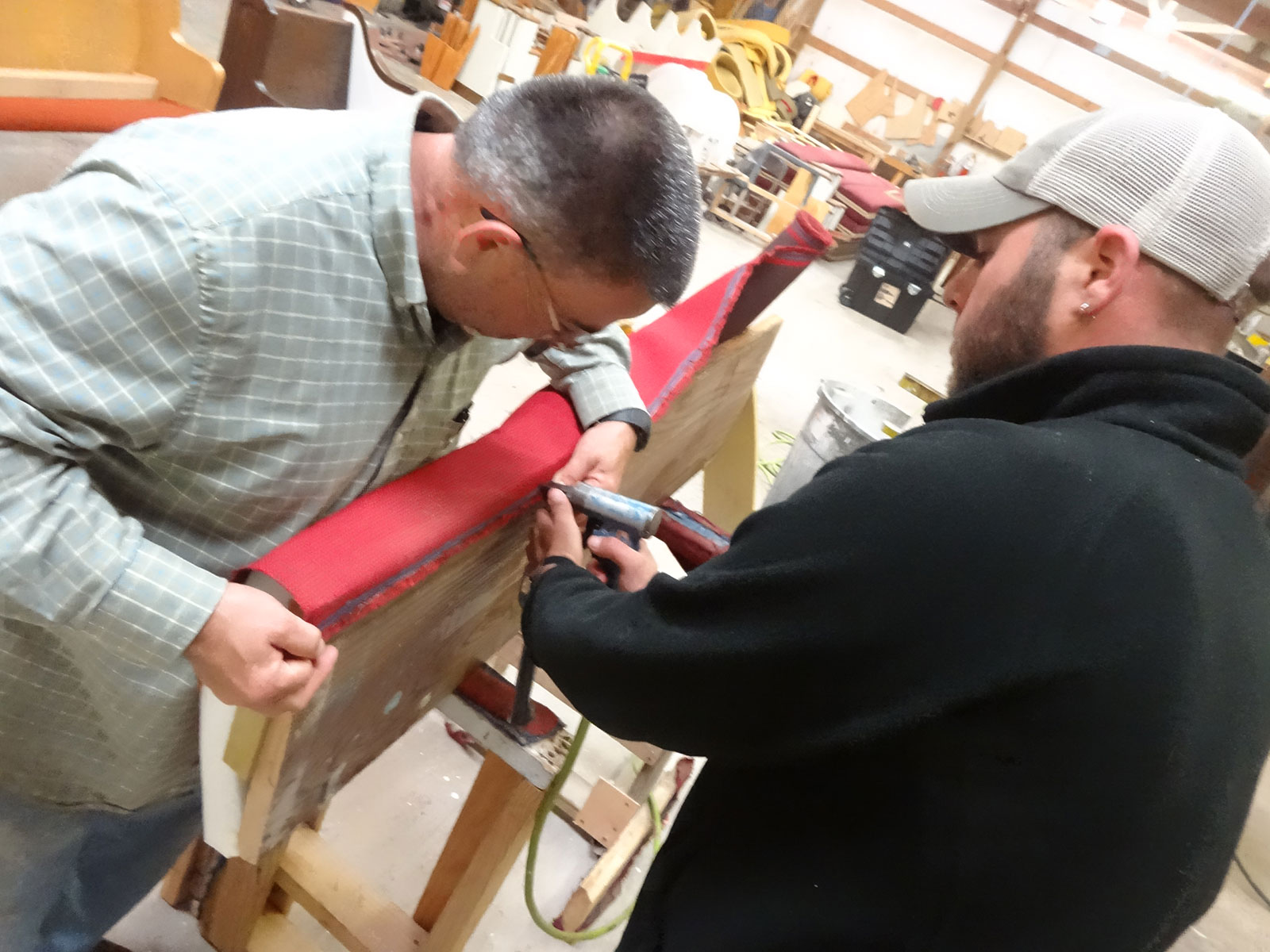
This is the question that determines the value of every other answer. Pew restoration involves upholstery, wood refinishing, structural repair, and installation. When those are split across different crews, no single party is accountable for the finished pew, and a warranty claim in year six turns into a conversation about whose stage failed.
Our answerAll work is completed in-house by our own team. No outside contractors, at any stage.
Where do your materials come from, and what foam do you use?
Ask about foam by name, not as a category. Foam is where a low bid usually hides, because a cheaper grade looks and feels identical on installation day and then compresses within a few years under weekly use. Wood and fabric sourcing is worth asking about for the same reason.
Our answerWood, fabric, and foam are all sourced domestically. Our cushions use high-quality LUX foam, chosen for durability under regular congregational use. See lay-in pew cushions for how that side works.
What is the warranty, on what exactly, and who honors it?
There is no industry standard here, which is precisely why the question separates companies. Get the term in writing, get the scope in writing, and if the company subcontracts, ask who is actually on the hook when a seam opens up in year eight.
Our answerA 15-year warranty on upholstery work, which is rare in this trade. We can offer it because we do every stage ourselves and are still the party you call.
Will you work around our calendar, including things that come up on short notice?
Services are the easy part, because they are predictable. Funerals are not. A company that can only work in one uninterrupted block is going to run into your church’s actual life at some point, and the sanctuary will be the thing that gives.
Our answerWe work in stages around Sunday services, weddings, funerals, and events so the sanctuary stays usable throughout. This is how we run every project, not a special accommodation.
Is your default to repair or to replace, and why?
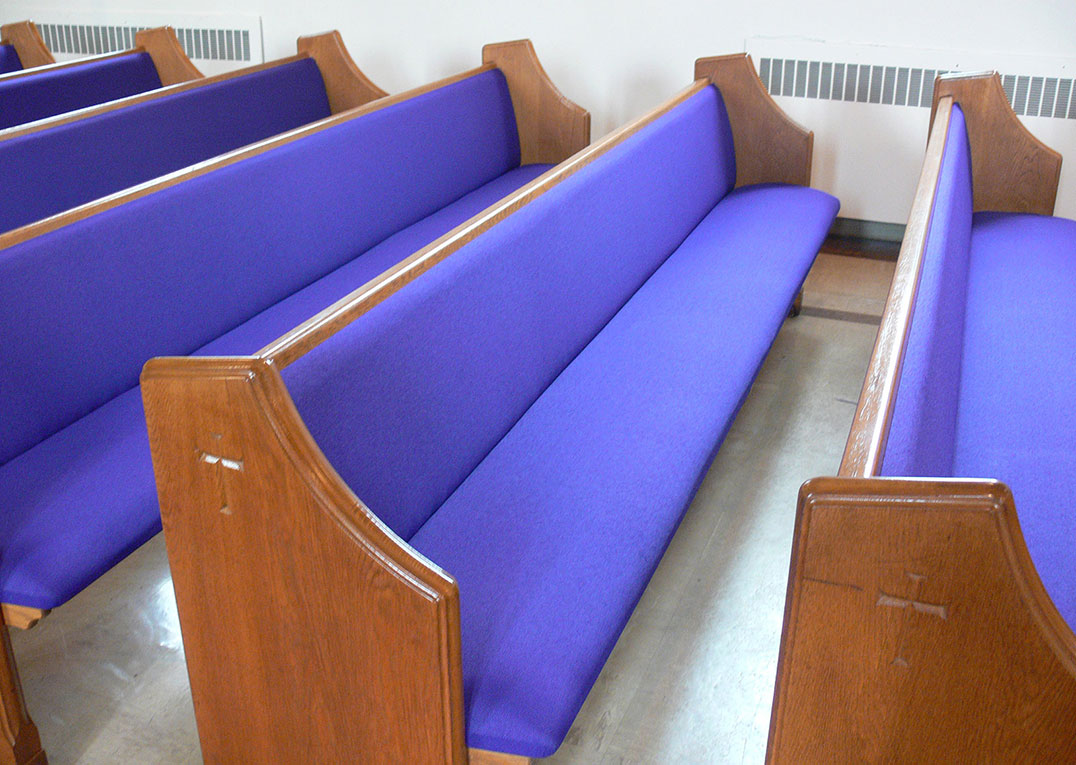
Ask them to justify the recommendation against your actual pews, in your sanctuary, not from photographs. Older Rocky Mount pews are frequently built from dense old-growth wood that no longer exists commercially at that quality, which usually makes repair both the cheaper answer and the better one.
Our answerRepair first, and we will tell you when it is not the right call. Structural work runs through pew parts and repairs, surface work through church pew refinishing.
Can you match the existing pew line if we phase this over several years?
Most church budgets phase this work, and phasing only succeeds if the finished sanctuary reads as one continuous pew line rather than three separate projects done at three different times. Ask specifically about color-matching across years, not just within a single job.
Our answerYes. We use proprietary in-house coating formulas and offer color-matching with design recommendations, and because the same team stays on the account, phase three still matches phase one.
Who handles removal, transport, and reinstallation?
A pew is heavy, awkward, and often anchored. The moment a sanctuary’s furniture is being moved by a crew who did not restore it and will not be back, small damage becomes nobody’s responsibility.
Our answerOur own team, through pew installations and deliveries, including disassembly, transport, and reinstallation.
Can we see finished sanctuaries, and how many of these have you done?
Ask for before-and-after photographs of whole sanctuaries rather than close-up product shots, and ask for a number. Experience with pews specifically is not the same as experience with furniture generally.
Our answerMore than 2,000 completed church pew restorations, with over 30 years of combined staff experience. Before-and-after work is in our photo gallery.
Three Answers That Should Give You Pause
- A firm quote without an in-person look. Nobody can price a pew line honestly from photographs. A number given over the phone is a number that will change, usually upward, once someone actually sees the frames.
- Full replacement recommended before the pews were inspected. Replacement is sometimes right. It is never right as an opening position on a historic sanctuary’s original wood.
- Vagueness about who does the work. If a company will not say plainly whether the upholstery, the refinishing, and the installation are their own people, assume they are not, and price the warranty accordingly.
What Happens When You Call Us
The consultation and quote are free, and they happen in your sanctuary. We walk the pew line, assess frame condition, veneer, finish, and joints separately, and prioritize repairs by what genuinely needs attention now against what can wait a few budget cycles. Nothing gets assumed from a phone call.
If your building sits in one of Rocky Mount’s historic districts, it is also worth confirming whether any preservation conditions apply before work begins, particularly if the church has ever used state or federal preservation tax credits tied to the property. The North Carolina State Historic Preservation Office is the right place to check.
From there, the scope is yours to set. A full church furniture services project, a phased plan across several years, or a single section of pews that has taken the worst of it. General project questions are answered on our FAQ page.
What Congregations Say
See recent updates and photos on our Facebook page.
Serving Rocky Mount, Nash County, and Edgecombe County
Rocky Mount sits inside McPhail Church Services’ Eastern North Carolina territory, alongside Wilson, Greenville, Goldsboro, and New Bern. From our shop in Autryville we travel across the region for consultations, on-site repairs, and full restoration projects. Our North Carolina church pew services page covers how we work statewide, and the about us page introduces the family behind the shop.
Frequently Asked Questions
Does it matter whether a pew restoration company subcontracts the work?
It matters more than almost anything else you can ask about. When upholstery, wood refinishing, structural repair, and installation are split across different crews, no single party is accountable for the finished pew, and a warranty claim years later becomes a question of whose work failed. McPhail completes every stage in-house with no outside contractors, which is what makes a long warranty possible to honor.
What should a church ask about materials?
Ask specifically where the wood, fabric, and foam come from, and ask about the foam by name rather than as a general category. Foam is where a low bid usually hides, because a cheaper grade looks identical on installation day and compresses within a few years under regular use. McPhail sources wood, fabric, and foam domestically and uses high-quality LUX foam in its cushions.
How long should a church pew upholstery warranty last?
There is no industry standard, which is exactly why the question is worth asking. McPhail carries a 15-year warranty on upholstery work, which is unusually long for this trade. The follow-up question matters just as much: ask what the warranty actually covers, get it in writing, and confirm who honors it if the company that sold it subcontracted the work.
Will a pew restoration project force us to cancel services?
It should not. Ask directly whether the schedule will be built around your church calendar, including weddings and funerals that get added on short notice. McPhail works in stages around Sunday services and events so the sanctuary stays usable throughout the project, and handles removal, transport, and reinstallation with its own team.
How do we know whether our pews should be repaired or replaced?
Ask what the company’s default is, and ask them to justify it against the actual condition of your pews rather than a photograph. Older pews in Rocky Mount’s historic sanctuaries are often built from dense old-growth wood that cannot be matched with new material, so repair is usually both the cheaper and the better answer. A company that recommends full replacement without inspecting the frames has not done the work of finding out.
Can a pew restoration project be phased across budget years?
Yes, and most are. Ask two things: whether the company will prioritize by condition during the consultation, and whether they can color-match a section refinished years later to the sections done earlier. A phased project only works if the finished sanctuary reads as one pew line rather than as three separate projects.
Are churches in Rocky Mount’s historic districts subject to special rules?
It depends on the building’s designation and on whether the church has used state or federal preservation tax credits or grants tied to the property. Rocky Mount Central City Historic District alone holds 166 contributing buildings. The North Carolina State Historic Preservation Office is the right resource to confirm what applies to a specific building before work begins.
What proof of past work should we ask to see?
Ask for before-and-after photographs of finished sanctuaries rather than product shots, and ask how many pew restorations the company has actually completed. McPhail has completed more than 2,000 church pew restorations with over 30 years of combined staff experience, and keeps a before-and-after photo gallery on its site.
Get a Free Quote for Your Rocky Mount Church
Ask us the eight questions above. If the answers hold up better than the other bids, we would be glad to walk your sanctuary.
McPhail Church Services, Inc. · 59 Vickers Lane, Autryville, NC 28318 · 910-322-5673
Sources: Rocky Mount Central City Historic District, listed on the National Register of Historic Places June 19, 1980 with a boundary revision August 27, 2009, comprising 166 contributing buildings from the late 19th through mid 20th centuries, including the Church of the Good Shepherd (1877) and Holy Hope Episcopal Church (1910s). Lincoln Park Historic District, Edgecombe County, 47 contributing buildings. Rocky Mount Mills, built 1818, the second cotton mill in North Carolina. Churches are cited here as historic district architecture only.