

Installing pews in a historic Philadelphia church requires careful planning. Many churches in Philadelphia have unique architectural features – narrow aisles, stone columns, or raised platforms – that affect seating layout. Follow these steps to ensure a smooth, safe pew installation:
- Evaluate and Measure the Space: Begin by measuring your sanctuary’s dimensions, including length, width, and ceiling height. Note any fixed obstacles like columns, alcoves, or steps. Also measure doorways and corridors if you’ll move pews in pieces. Philadelphia’s older churches often have tight entryways, so confirm that each pew or pew section will fit through hallways and doors before planning the layout.
- Plan Your Layout: Sketch a scale diagram of the sanctuary and plot pew rows, center aisle, and side aisles. Aim for at least a 5-foot-wide main aisle and about 3-foot side aisles. Standard guidance also calls for roughly 36 inches of front-to-front spacing between rows. Check local building and fire codes – churches must comply with occupancy rules for public assembly. Ensure your design maintains all required exit paths and includes space for accessible seating (for example, a 36-inch-wide route for wheelchairs).
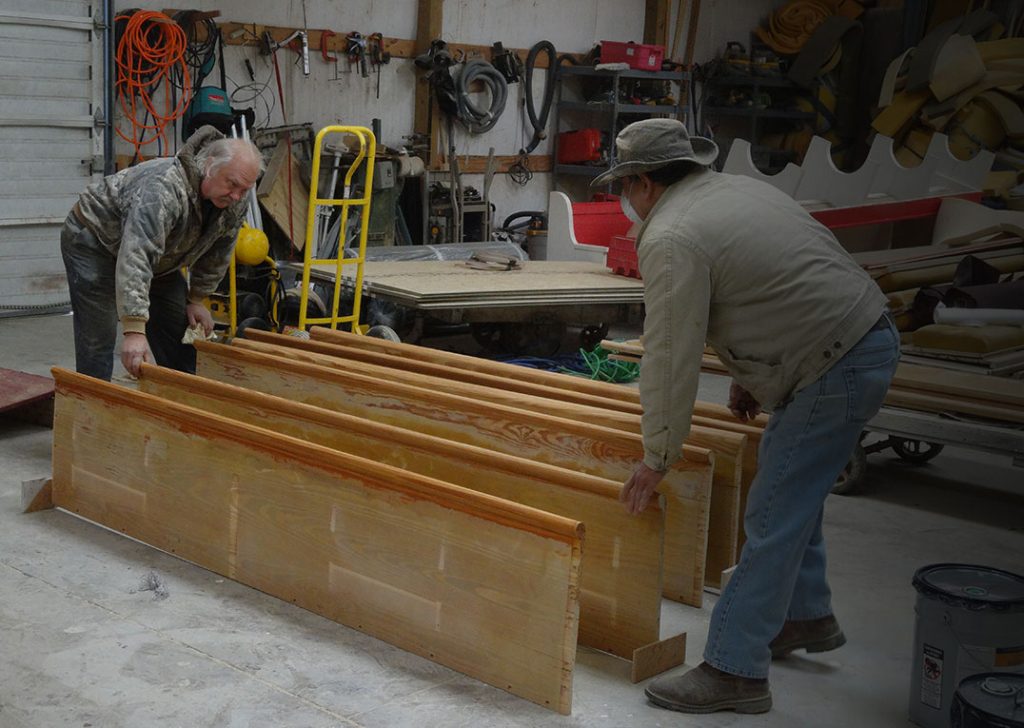
- Prepare the Pews: If you’re reusing existing or used pews, it’s best to disassemble them before moving. As McPhail notes, “It is generally best for the used church furniture to be completely taken apart to its basic parts, shipped to its destination then installed as if it were new furniture”. One important point: pew support legs are often cut to fit a specific floor height. After moving, you may need to trim or adjust each leg for a level fit. Move the pew sections into place near their final positions before reassembling.
- Install and Anchor Pews: Starting with the front row, place each pew and use a level to ensure it’s straight. Secure pew ends firmly to the floor – proper anchoring prevents wobbling. McPhail offers anchoring solutions because loose pew ends are a common issue. Also, be sure to re-anchor or fasten furniture so it meets all fire-safety codes. Continue placing pews row by row, always checking measurements. Make sure each row is aligned, that seating lines are even, and that hymnals, kneelers, and cup holders are positioned uniformly.
- Final Checks: Walk all aisles and pathways to verify clearances match your plan. Confirm that exit routes remain at least the minimum width and that pews do not obstruct any signage or doors. Sit on a few pews to test stability. Once everything is level, anchored, and code-compliant, your installation is complete.
Pew installation is a job that calls for experience and precision. Contact McPhail Church Services for professional pew installation in Philadelphia, PA. Our team can handle the planning, measuring, moving, and anchoring – ensuring your new pew layout is safe, comfortable, and compliant with all codes.